Bible Verses About Strength
Whether you’re exhausted, afraid, or running on nothing. These are the verses for days when you need more than you have.
The 5 Best Bible Verses About Strength
If you need one right now and don’t have time to scroll, start here.
- 1.
“I can do all things through Christ who strengthens me.”
Philippians 4:13
- 2.
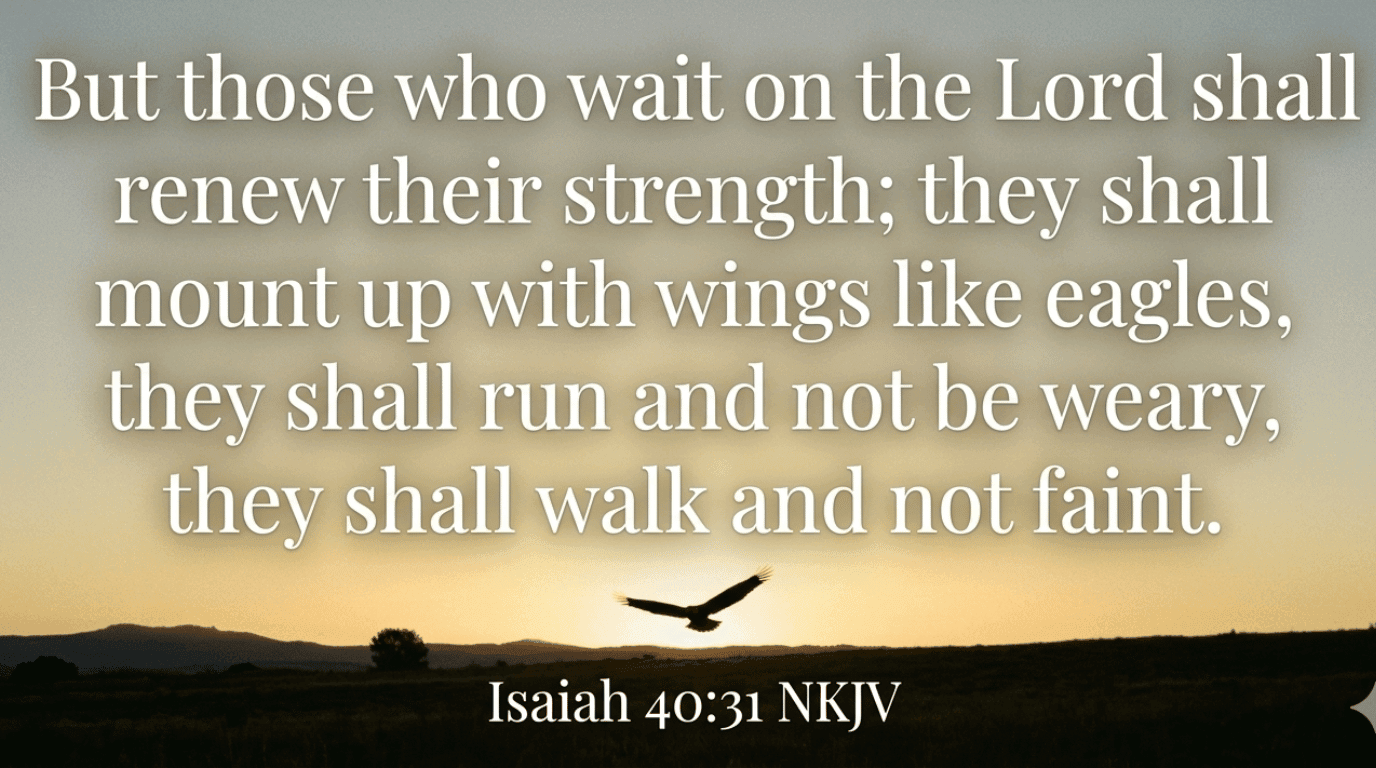
“But those who wait on the Lord shall renew their strength; they shall mount up with wings like eagles, they shall run and not be weary, they shall walk and not faint.”
Isaiah 40:31
- 3.
“Have I not commanded you? Be strong and of good courage; do not be afraid, nor be dismayed, for the Lord your God is with you wherever you go.”
Joshua 1:9
- 4.
“Fear not, for I am with you; be not dismayed, for I am your God. I will strengthen you, yes, I will help you, I will uphold you with My righteous right hand.”
Isaiah 41:10
- 5.
“My grace is sufficient for you, for My strength is made perfect in weakness.”
2 Corinthians 12:9
There’s a version of strength the world sells that I’ve never actually had access to. The kind where you reach down into some untapped reserve of personal will and power through on grit alone. I’ve tried to be that person. It didn’t work.
What I found instead was something the Bible describes completely differently. Not a reserve I have. A source I don’t. The strength Scripture talks about almost always starts with the end of the person’s own. That’s the pattern. You run out, and something else shows up.
I organized these twenty-eight Bible verses about strength by what you might actually be feeling right now, not by which book of the Bible they come from. Old Testament vs. New Testament isn’t how your brain works at two in the morning. What you’re thinking is: I’m exhausted. I’m scared. I don’t know how much longer I can do this. So that’s how this page is sorted.
When You’re Running on Empty
For the tired that sleep doesn’t fix
There’s a kind of empty that eight hours of sleep doesn’t touch. You can lie down exhausted and wake up just as depleted. I’ve come to think that kind of fatigue isn’t physical. It’s what happens when the output has been greater than the input for a long time. When you’ve been giving from something that wasn’t being replenished.
These aren’t verses about trying harder. They’re verses about what God does with people who have nothing left.
Isaiah 40:29
“He gives power to the weak, and to those who have no might He increases strength.”
Notice what this verse doesn’t say. It doesn’t say He gives power to those who’ve been faithful enough, or consistent enough, or put-together enough. It says to the weak. The people who have no might at all. I spent years trying to not be that person, trying to look like I had more reserves than I did. This verse made me stop. God isn’t waiting for you to fix the weakness before He shows up. The weakness is where He shows up. That’s not a consolation prize. That’s the deal.
Isaiah 40:31
“But those who wait on the Lord shall renew their strength; they shall mount up with wings like eagles, they shall run and not be weary, they shall walk and not faint.”
The order in this verse has always caught me. Soar, then run, then walk. That’s backwards from what you’d expect. You’d think it would build from walking up to soaring. But I think it’s listed this way because of where most of us actually start. Sometimes you can’t run. You can’t even walk. And Isaiah says even then, you can soar. The waiting Isaiah describes isn’t sitting around doing nothing. It’s the posture of someone who has stopped depending on their own legs and started depending on something else entirely. That shift is what the renewal is built on. For the full meaning of qavah and why the order in this verse is backwards, this article explains it.
Matthew 11:28-29
“Come to Me, all you who labor and are heavy laden, and I will give you rest. Take My yoke upon you and learn from Me, for I am gentle and lowly in heart, and you will find rest for your souls.”
Jesus said this to people who were worn out by religion. The religious leaders of His day had piled requirement on top of requirement until following God felt like a second job nobody could afford. That’s still happening. I’ve watched people leave churches more depleted than they arrived because they confused carrying more obligation with following Jesus. This invitation isn’t for the lazy. It’s for the ones who’ve been working hard in the wrong direction for so long they’ve forgotten what rest actually feels like. Jesus says: come to me. Not to a system. To him.
Psalm 46:1
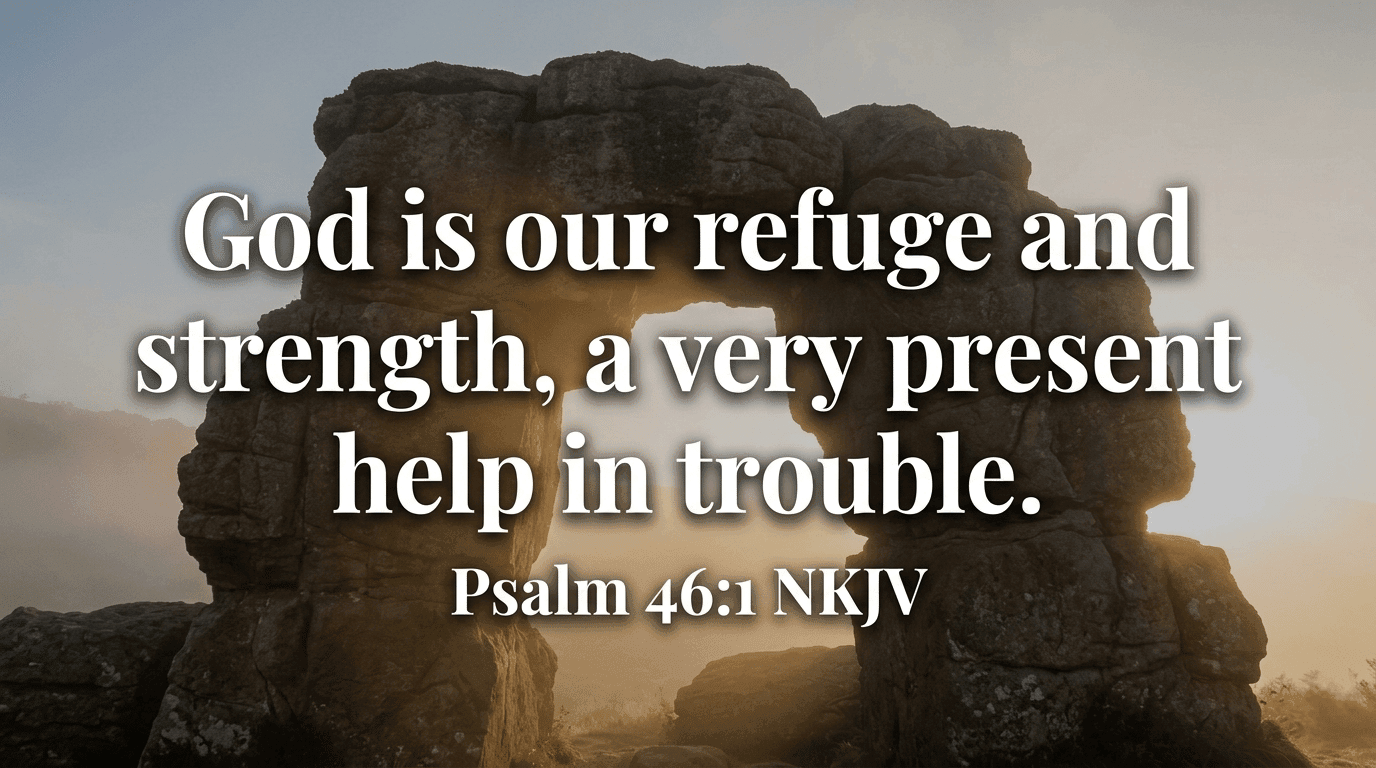
“God is our refuge and strength, a very present help in trouble.”
Three words I keep coming back to: very present help. Not a distant God who receives prayer requests and processes them later. Not a God who intervenes when things get catastrophically bad. A very present help. Present right now. Present in the middle of it, before it resolves. I’ve leaned on this verse in ministry when multiple things were falling apart at once and I couldn’t see how any of them would hold. You can’t build a refuge out of your own strength. But God isn’t just something you run to. He’s the refuge itself.
“The waiting isn’t passive. It’s the posture of someone who has stopped trusting their own legs and started trusting something else. That’s not weakness. That’s actually where the verse kicks in.”
When Fear Is Louder Than Faith
For the ones who believe and are still afraid
Being afraid doesn’t mean your faith is broken. I want to say that up front because there’s a version of Christianity that treats fear as a faith problem, and I think that framing has done real damage to real people. The command “do not be afraid” appears throughout Scripture. Commands are only necessary for things that are actually happening. God told people not to fear because they were afraid. He didn’t shame them for it.
You can believe completely in God and still feel genuinely terrified. These verses don’t promise the feeling will disappear. They give you something stronger to stand on than the fear.
Joshua 1:9
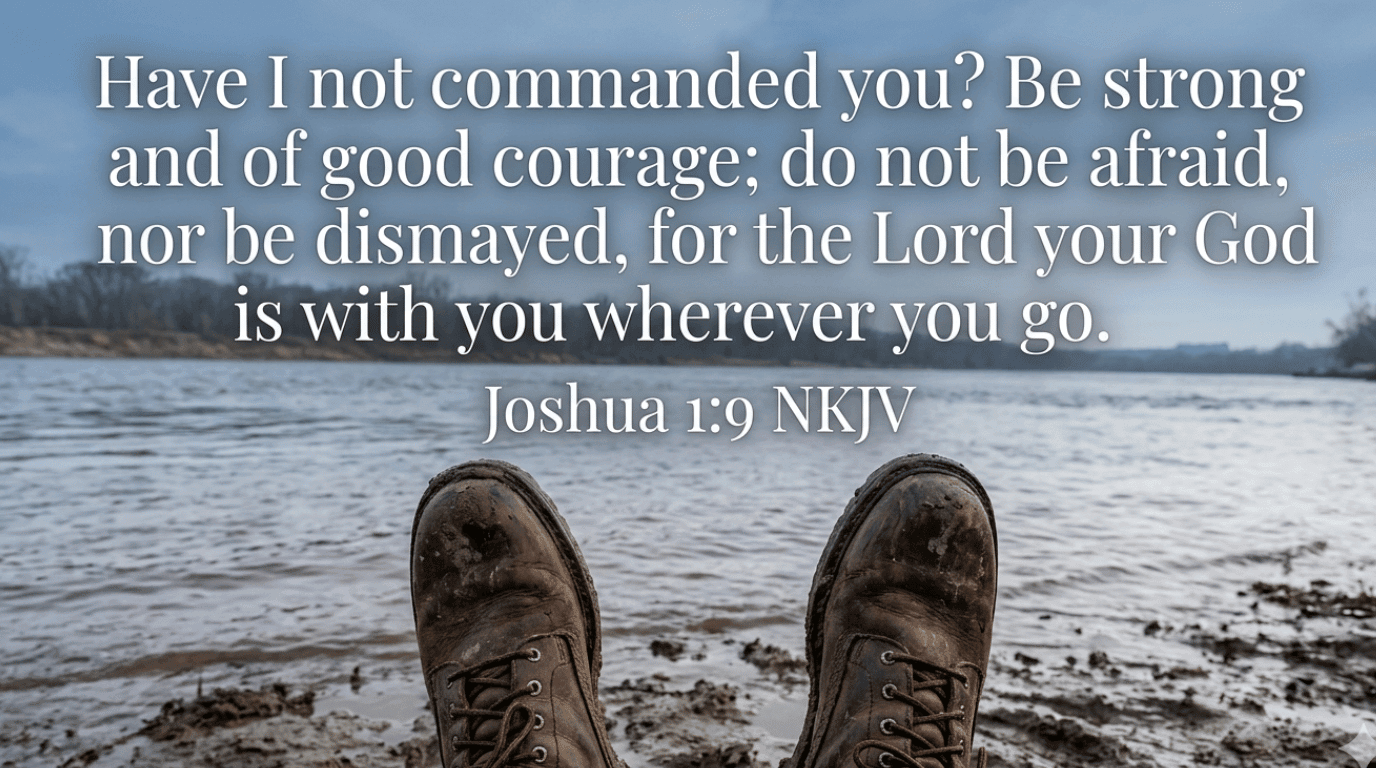
“Have I not commanded you? Be strong and of good courage; do not be afraid, nor be dismayed, for the Lord your God is with you wherever you go.”
Joshua just took over from Moses. Moses, who parted the Red Sea and talked with God face to face. Those were the shoes Joshua was stepping into, with an entire nation looking to him and the promised land ahead. God doesn’t say “you’ve got this.” He says “I’m with you.” That’s the whole source of the courage. Not Joshua’s gifting or leadership ability. The presence of God. When I’ve found myself in situations I wasn’t qualified for, that’s the piece I’ve come back to. Not “be strong because you’re strong enough.” Be strong because He is with you. For the full context of why God had to say it four times, and what chazaq and amats actually mean, this article goes deeper.
Isaiah 41:10
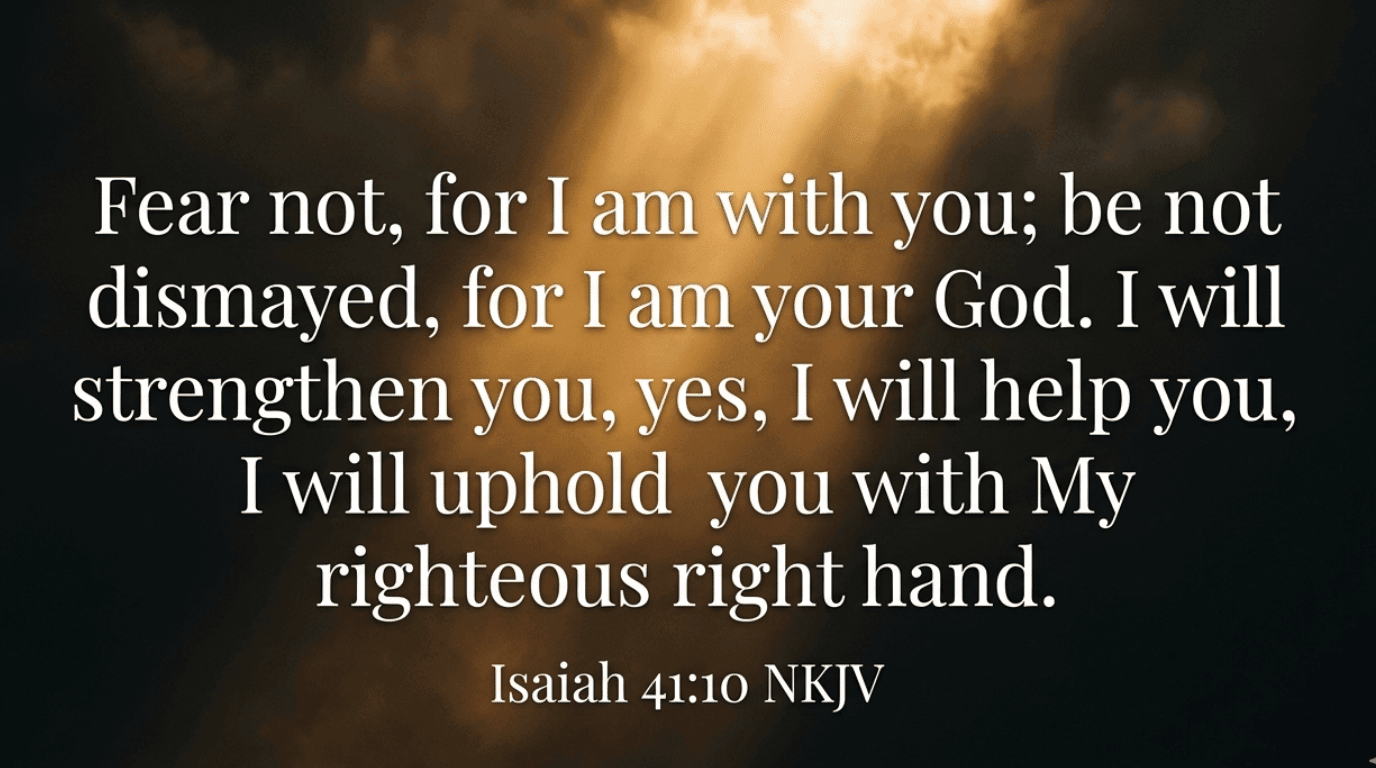
“Fear not, for I am with you; be not dismayed, for I am your God. I will strengthen you, yes, I will help you, I will uphold you with My righteous right hand.”
Four promises stacked in one verse. Strengthen, help, uphold, hold with His right hand. The “yes, I will help you” in the middle isn’t redundant. It’s emphasis. God knows we need to hear things more than once, especially when fear is loud. This is one of the most quoted strength and courage scriptures in the Bible because it covers the full weight of what people are actually afraid of. Not “it’ll be fine.” Not “stay positive.” I will strengthen you. I will help you. I will hold you. That’s a different kind of strength. That’s the kind that comes from outside the person.
2 Timothy 1:7
“For God has not given us a spirit of fear, but of power and of love and of a sound mind.”
Paul wrote this to Timothy, who was young and facing real opposition and probably felt it. The spirit of fear here isn’t just the feeling of being afraid. It’s the paralyzing kind. The kind that shuts you down and convinces you that moving forward is pointless and the worst case is certain. Paul says: that didn’t come from God. That spirit is not His. And in place of it, God gave three specific things: power, love, and a sound mind. That last one is what I come back to most. When fear is loudest, my mind is usually the least sound. This verse names that and offers a recalibration.
Psalm 27:1
“The Lord is my light and my salvation; whom shall I fear? The Lord is the strength of my life; of whom shall I be afraid?”
David asked two questions here that he already knew the answer to. That’s not a literary device. It’s a practice. When fear starts to talk, David’s method was to ask himself out loud: of whom shall I be afraid? Not “am I afraid?” Because you might be. But “of whom?” Who or what is actually worth fearing more than the God who is the strength of my life? I’ve started doing this. Not as a way to fake courage, but as a way to get back to what’s actually true when fear is making a lot of noise about what isn’t.
When You’re in the Middle of the Fight
Not before the battle. Not after. Right in it.
There’s a particular kind of hard that belongs to the middle. You can’t see the end. You’ve already spent more than you thought you had. And you’re still standing in something that hasn’t moved. Strength in that moment isn’t about getting through. It’s about staying upright in something that’s still going.
The Bible has a lot to say about this. Not about winning easily, but about standing when the ground is shaking.
Ephesians 6:10
“Finally, my brethren, be strong in the Lord and in the power of His might.”
Paul wrote “be strong in the Lord,” not “be strong through the Lord.” That preposition matters. Through implies a channel. In implies a location. Where are you standing? Are you trying to access God’s strength from a distance, or are you positioned in it the way you’d be inside a room? Paul opens the whole armor of God passage with this verse because the armor is secondary. You don’t start with the gear. You start with where you’re standing. Positioned in the Lord and in the power of His might. That’s the foundation everything else is built on.
Romans 8:37
“Yet in all these things we are more than conquerors through Him who loved us.”
The context of this verse is a list of things that cannot separate us from God’s love: tribulation, distress, persecution, famine, danger, sword. Paul says in all these things, we are more than conquerors. Not after. Not on the other side of them. In. The word Paul used is hypernikomen in Greek. Overwhelming, exceeding victory. Not surviving. Not barely making it. More than conquerors. Inside the hard things, not once they’re resolved. That’s a different kind of strength than what we usually mean when we talk about overcoming something.
1 Corinthians 16:13
“Watch, stand fast in the faith, be brave, be strong.”
Four commands. No explanation. No qualifier. No “if you can.” Watch. Stand fast. Be brave. Be strong. There are times when the right verse isn’t the long one with the beautiful imagery. Sometimes you need something short and direct enough to cut through everything else. I’ve kept this one in my phone for exactly that reason. Not as a checklist, but as a reset. When I feel the ground starting to give, these four commands are enough to get my feet back under me.
Psalm 18:32
“It is God who arms me with strength, and makes my way perfect.”
Arms me. Not loans. Not offers if I’m qualified. Arms, like a soldier being equipped before going in. David wrote this Psalm after God delivered him from his enemies, and he is carefully tracing the victory back to its source. He doesn’t take credit for the win. He names who armed him. I try to do the same thing in my own life. When I make it through something that had no good reason to end well, I want to be the kind of person who looks back and names what held me up instead of congratulating myself on how resilient I am.
“Paul says ‘in all these things’ we are more than conquerors. Not after. Not on the other side of them. In. Strength that functions inside the hard, not only once it’s resolved.”
When You Want to Quit
For the moment right before you stop
Quitting isn’t always a dramatic decision. Sometimes it’s just not going back. Not making the call. Not showing up again. Slowly reducing the distance between yourself and the exit until one day you’re just gone. I’ve felt that pull. I know what it’s like to be so tired of something that not doing it anymore seems like the only rational option.
The Bible doesn’t shame the person who wants to quit. But it has something real to say to them.
Galatians 6:9
“And let us not grow weary while doing good, for in due season we shall reap if we do not lose heart.”
Paul doesn’t say “if you keep pushing hard enough.” He says “if we do not lose heart.” The heart is the thing. You can keep going through the motions after your heart has left. Paul is aiming at what’s underneath the behavior. If your heart is still in it, the harvest is coming. “In due season” isn’t a cruel answer. It’s an honest one. The timing is real and it’s outside your control. But losing heart before you see it is the one variable that actually ends the story early. Quitting isn’t the harvest. It’s the decision not to wait for one.
Hebrews 12:1
“Therefore we also, since we are surrounded by so great a cloud of witnesses, let us lay aside every weight, and the sin which so easily ensnares us, and let us run with endurance the race that is set before us.”
The cloud of witnesses is everyone from Hebrews 11 who ran before you. Abel, Enoch, Noah, Abraham, Moses, Rahab. People who didn’t quit when quitting would have been completely understandable by any reasonable measure. The writer says: they’re watching. Not as judges. As the crowd that’s already crossed the line. When I’m in the middle of something hard, thinking about the people who came before me and refused to fold carries real weight. I am not the first person to feel this way. They felt it. They kept going. They finished.
Romans 5:3-4
“And not only that, but we also glory in tribulations, knowing that tribulation produces perseverance; and perseverance, character; and character, hope.”
The word “glory” threw me for years. Who glories in tribulation? But Paul’s point isn’t to be cheerful about pain as though it isn’t painful. It’s to understand what the pain is producing. Perseverance leads to character. Character leads to hope. Every step in that chain requires the one before it. You can’t shortcut the tribulation and still get the character. You can’t skip the perseverance and still find yourself with something worth calling hope. This is not prosperity gospel. This is the cross-shaped path that actually leads somewhere real.
James 1:2-4
“My brethren, count it all joy when you fall into various trials, knowing that the testing of your faith produces patience. But let patience have its perfect work, that you may be perfect and complete, lacking nothing.”
I used to read this and feel faintly guilty for not being joyful about hard things. But “count it all joy” is not a command to feel happy about suffering. It’s a command to know something. To look at a trial and know what it’s working in you even when you can’t feel anything working. The word translated “patience” here is the Greek hupomone, which is better rendered as steadfast endurance under pressure. The joy isn’t the emotion. It’s the perspective of someone who sees past what’s happening right now to what’s being built.
When You Don’t Feel Strong Enough
For the ones who’ve stopped pretending they have what it takes
There are two versions of this feeling. The dishonest one is the inner critic that tells you you’re worthless, you’ll never make it, you’re too far gone. That’s not truth. The honest version is the quiet acknowledgment that this is bigger than you. That you’ve tried everything and you’ve come up short. That honest version isn’t the enemy. It’s actually the beginning of something.
These are the verses for when you’ve stopped performing strength you don’t have.
Philippians 4:13
“I can do all things through Christ who strengthens me.”
This is the most searched Bible verse about strength. It’s on gym walls, graduation cards, and phone cases. I’m not annoyed by that. I just want you to know where Paul wrote it from. He was under Roman house arrest, in chains, waiting to find out if he’d be executed. The “all things” he was describing included being abased, suffering need, going hungry, and being in prison. This is not a success mantra. It’s not a verse about achieving goals. It’s a statement of sufficiency. Whatever my circumstances are, Christ gives me the strength to face them. That’s a different thing than performing. It’s not about being strong enough. It’s about a source that doesn’t run out even when you do. For the full context of where Paul wrote this and what it actually means, this article goes deeper.
2 Corinthians 12:9-10
“And He said to me, 'My grace is sufficient for you, for My strength is made perfect in weakness.' Therefore most gladly I will rather boast in my infirmities, that the power of Christ may rest upon me. Therefore I take pleasure in infirmities, in reproaches, in needs, in persecutions, in distresses, for Christ's sake. For when I am weak, then I am strong.”
Paul asked God three times to remove his thorn in the flesh. We don’t know what it was. Paul doesn’t say. What God told him is the part that matters: my grace is sufficient for you. Not “I’ll remove it.” Not “relief is around the corner.” Sufficient. What I’m giving you right now is enough for what you’re in right now. That’s a hard word to receive when you want something different. And then the verse ends with the thing that changes everything: “when I am weak, then I am strong.” That’s not a paradox designed to confuse you. It’s the actual mechanism. Weakness surrendered to God is exactly where His strength enters. Not your strongest moments. Your weakest ones.
Psalm 28:7
“The Lord is my strength and my shield; my heart trusted in Him, and I am helped; therefore my heart greatly rejoices, and with my song I will praise Him.”
Three movements in this verse: trust, help, praise. You don’t start with praise. You start with trust. “My heart trusted in Him, and I am helped.” The help follows the trust, and then the praise follows the help. I catch myself wanting to shortcut this. I want to feel like praising God before I’ve actually handed Him the thing that’s heavy. This verse doesn’t let you do that. Trust is the first move. And the promise is that the help comes after you make it, not before.
Isaiah 12:2
“Behold, God is my salvation, I will trust and not be afraid; for Yah, the Lord, is my strength and song; He also has become my salvation.”
“My strength and song” in the same breath. Strength made sense to me early. Song took longer. Songs are for people who feel like singing. What about when you don’t? I think Isaiah is saying that the strength God provides doesn’t only carry you through hard things. Eventually it produces something in you worth expressing out loud. That takes longer than most of us want. But there’s a real line between the early days of just surviving and the later days when you can look back and find something like music in it. Isaiah is describing where that comes from.
“The ‘all things’ in Philippians 4:13 includes prison. Paul didn’t write that verse from a winning streak. He wrote it from chains. It’s not a success mantra. It’s a statement of sufficiency from someone who found out that Christ’s strength was enough even there.”
When You’re Carrying Too Much
For the ones who’ve been holding things alone for too long
One of the most common things I see in ministry is people who’ve been carrying weights that were never theirs to carry alone. A mom covering for her son for three years. A dad who’s been the steady one through everyone else’s crisis. Someone who convinced themselves that staying calm and holding it together would somehow keep the whole thing from falling apart.
You can only run on that for so long. These verses aren’t for people who want to give up. They’re for people who’ve been holding on past the point God asked them to do it solo.
Psalm 55:22
“Cast your burden on the Lord, and He shall sustain you; He shall never permit the righteous to be moved.”
The word “cast” is not a gentle word. It means to throw. David is not saying politely offer your burden upward. He’s saying throw it. Hard. There’s desperation in that image. There’s also permission. You’re not required to carry this with dignity and composure. You’re supposed to throw it, hard, at the God who can hold what you can’t. My natural instinct is to manage things until I can’t anymore and then quietly fall apart in private. This verse gives me an earlier option. You don’t have to wait until you’re broken to let it go.
1 Peter 5:7
“casting all your care upon Him, for He cares for you.”
Four words at the end change the whole verse: for He cares for you. Peter doesn’t say cast your care on God because He can handle it, though He can. He says cast it because He cares. The reason isn’t God’s capacity. It’s His attention. He isn’t asking you to give Him your burdens because He’s obligated to manage them. He’s asking because He is actually paying attention to you specifically, to this thing specifically. That’s a different kind of God than the one religion sometimes presents. Not a cosmic administrator. A Father who is watching and who cares about the specific weight you’re holding right now.
Psalm 34:17-18
“The righteous cry out, and the Lord hears, and delivers them out of all their troubles. The Lord is near to the brokenhearted, and saves such as have a contrite spirit.”
“The Lord is near to the brokenhearted.” Not to the strong. Not to the ones who have it figured out. To the brokenhearted. I’ve preached this verse at funerals and at recovery meetings. What I’ve noticed is that people who are in real pain hear it differently than people who are doing fine. When your heart is actually broken, “God is near” isn’t abstract anymore. It’s the only thing that makes the next breath possible. He didn’t promise to fix everything immediately. He said He’s near. For some of us in some moments, that’s exactly enough to start with.
Nahum 1:7
“The Lord is good, a stronghold in the day of trouble; and He knows those who trust in Him.”
Nahum is a minor prophet who barely gets quoted, and this verse deserves more attention than it gets. A stronghold isn’t just shelter from the storm. It’s a fortified position. A place you can hold ground from. God isn’t only a place to run when things go wrong. He’s a position of strength you can stand in and operate from. And then the last part: He knows those who trust in Him. When you’re carrying too much and everything feels out of control, that sentence is one of the most stabilizing things in Scripture. He knows you. He is tracking. You are not invisible in this.
When You Need to Know You’re Not Alone
For the ones who’ve started to believe they’ve been forgotten
The loneliness that comes from sustained suffering is different from regular loneliness. It’s not just the feeling of being by yourself. It’s the beginning of a belief. That God either doesn’t see you or doesn’t care. That the people around you have stopped trying to understand. That you’ve somehow become invisible in your own pain.
These are the verses for that specific kind of alone.
Deuteronomy 31:6
“Be strong and of good courage, do not fear nor be afraid of them; for the Lord your God, He is the One who goes with you. He will not leave you nor forsake you.”
Moses said this to Israel right before he died. His last speech. He was handing the people off to Joshua after forty years of desert and miracles and failures and hard things that should have ended everything. And the last thing he wanted them to know was this: God goes with you. He won’t leave. He won’t abandon you. When a man who had walked with God through everything Moses had walked through makes that the final thing he says, you should take it seriously. He wasn’t being optimistic. He was reporting what he’d observed to be true over forty years.
Psalm 73:26
“My flesh and my heart fail; but God is the strength of my heart and my portion forever.”
Asaph wrote this Psalm in the middle of what sounds like a genuine faith crisis. He’d watched the wicked prosper while the righteous suffered, and he almost concluded that following God was pointless. Verse 26 is where he lands after working through all of it. Not “I got my answers.” Not “I finally understand why.” Just: my flesh fails, my heart fails, and God is my strength and my portion. Forever. I find this verse more honest than most. It doesn’t pretend Asaph got resolution. It just names what’s left when everything else gives way. God. That’s what’s left. And Asaph found it was enough.
Isaiah 26:4
“Trust in the Lord forever, for in Yah, the Lord, is everlasting strength.”
Everlasting isn’t a metaphor here. It means without end. The strength of God does not deplete. It doesn’t have bad days. It doesn’t get tired of you needing it. Whatever the specific thing is that has you reading a page about strength right now, everlasting is bigger than it. That’s the bet Isaiah is asking you to make. Not that things will get easier soon. Not that the hard part is almost over. That the source of strength you’re leaning on doesn’t have a bottom.
Zephaniah 3:17
“The Lord your God in your midst, the Mighty One, will save; He will rejoice over you with gladness, He will quiet you with His love, He will rejoice over you with singing.”
I’ve read a lot of descriptions of God. Powerful, holy, just, sovereign. All true. But this one stopped me cold. “He will quiet you with His love.” The image is of someone being stilled. Calmed. The God of the universe quieting a person the way you’d quiet a frightened child, with the warmth of His love. And then singing over them. I don’t fully understand that image. I can’t fully picture it. But Zephaniah says He does. When you feel like the opposite of someone worth singing over, when you feel forgotten and invisible and too far gone for any of this to apply, this verse is for you specifically.
STAY CONNECTED
Get a Verse in Your Inbox Every Week
Short reflections on Scripture for people rebuilding their lives. No fluff. Just what’s real.
No spam. Unsubscribe any time.
FAQ
Frequently Asked Questions About Bible Verses and Strength
What does the Bible say about strength?
+
The Bible’s definition of strength runs almost exactly opposite to the cultural one. Culturally, strength is capacity: the ability to handle more, endure more, perform more without breaking. Biblically, strength is almost always located outside the person. “The Lord is my strength” appears repeatedly from the Psalms through the New Testament. The clearest summary of the biblical view on strength is probably 2 Corinthians 12:9: “My strength is made perfect in weakness.” The Bible isn’t against human effort or endurance. But it consistently points past both to a source that doesn’t come from inside us. The 28 verses above are organized by what you’re feeling — if you want to find the ones most relevant to your situation right now, use the anchor nav at the top of the page.
What is the best Bible verse for when you're tired and weary?
+
Isaiah 40:31 is probably the most searched and most quoted verse for exhaustion: “But those who wait on the Lord shall renew their strength; they shall mount up with wings like eagles, they shall run and not be weary, they shall walk and not faint.” The notable thing about this verse is the order: it starts with soaring, not walking. It describes someone who starts from complete depletion and finds that waiting on God is how the renewal happens. Matthew 11:28-29 is equally direct for a different kind of tired: “Come to Me, all you who labor and are heavy laden, and I will give you rest.” Both of these are in the “When You’re Running on Empty” section above. For a deeper look at what the waiting in Isaiah 40:31 actually means in the original Hebrew, this article goes into the full context.
What does Philippians 4:13 really mean?
+
Philippians 4:13 is the most searched Bible verse about strength, and it’s also one of the most misunderstood. “I can do all things through Christ who strengthens me” is not a claim that a Christian can accomplish any goal they commit to. Paul wrote it while under Roman house arrest, in chains, waiting to find out whether he’d be executed. The “all things” in his context included hardship, poverty, suffering need, and imprisonment. What Paul is saying is that whatever his circumstances are, Christ gives him the strength to face them. It’s a verse about sufficiency, not success. The strength Christ provides is enough for what you’re in, not a guarantee of the outcome you’re hoping for. For the full context.
What does "when I am weak, then I am strong" mean?
+
This comes from 2 Corinthians 12:10, at the end of Paul’s account of asking God three times to remove his thorn in the flesh. God’s answer wasn’t removal. It was: “My grace is sufficient for you, for My strength is made perfect in weakness.” Paul concludes from this that he will actually boast in his weaknesses rather than hide them, because weakness is the exact condition under which Christ’s power works most visibly. “When I am weak, then I am strong” isn’t a contradiction designed to sound profound. It’s a description of the mechanism. When Paul has nothing left of his own, he is entirely dependent on Christ’s. And Christ’s doesn’t run out. Weakness surrendered is the beginning, not the end.
What are the best Bible verses about strength in hard times?
+
For strength specifically in sustained difficulty rather than a single hard moment, the most useful verses focus on perseverance rather than power. Romans 5:3-4 traces a chain from tribulation to perseverance to character to hope. James 1:2-4 describes trials as producing steadfast endurance. Galatians 6:9 is specifically about the fatigue of long faithfulness: “Let us not grow weary while doing good, for in due season we shall reap if we do not lose heart.” Isaiah 41:10 covers the full range: “Fear not, for I am with you… I will strengthen you, yes, I will help you, I will uphold you with My righteous right hand.” The “When You Want to Quit” and “When You’re in the Middle of the Fight” sections have the most relevant verses for hard times that aren’t ending quickly.
What does "be strong and courageous" mean in the Bible?
+
The command “be strong and courageous” appears multiple times in the Old Testament and is most closely associated with Joshua 1:9, where God gave it to Joshua before he led Israel into the promised land. The key to understanding it is the reason attached: “for the Lord your God is with you wherever you go.” The command isn’t an instruction to summon willpower. It’s a command grounded in a fact: God’s presence. Deuteronomy 31:6 frames it the same way: “Be strong and of good courage… for the Lord your God, He is the One who goes with you. He will not leave you nor forsake you.” In both cases, the courage flows from the presence that’s going with the person, not from any capacity they have on their own. Full deep-dive.
If You Need More Than a Verse Right Now
If you’re searching for strength because someone you love is in the middle of addiction, and you don’t know what to do next, we can help you figure out the next step.
Get Help →
Justin Franich
Justin Franich is a Teen Challenge graduate who overcame a meth addiction and has been clean since 2005. He spent over a decade leading Christ‑centered recovery programs and now serves as Executive Director of Shenandoah Valley Adult Teen Challenge, helping families find the right path forward and supporting people as they rebuild life after addiction.
Read my story →