After Recovery
WHEN SOBRIETY ISN'T ENOUGH: THE JOURNEY FROM CLEAN TO FREE
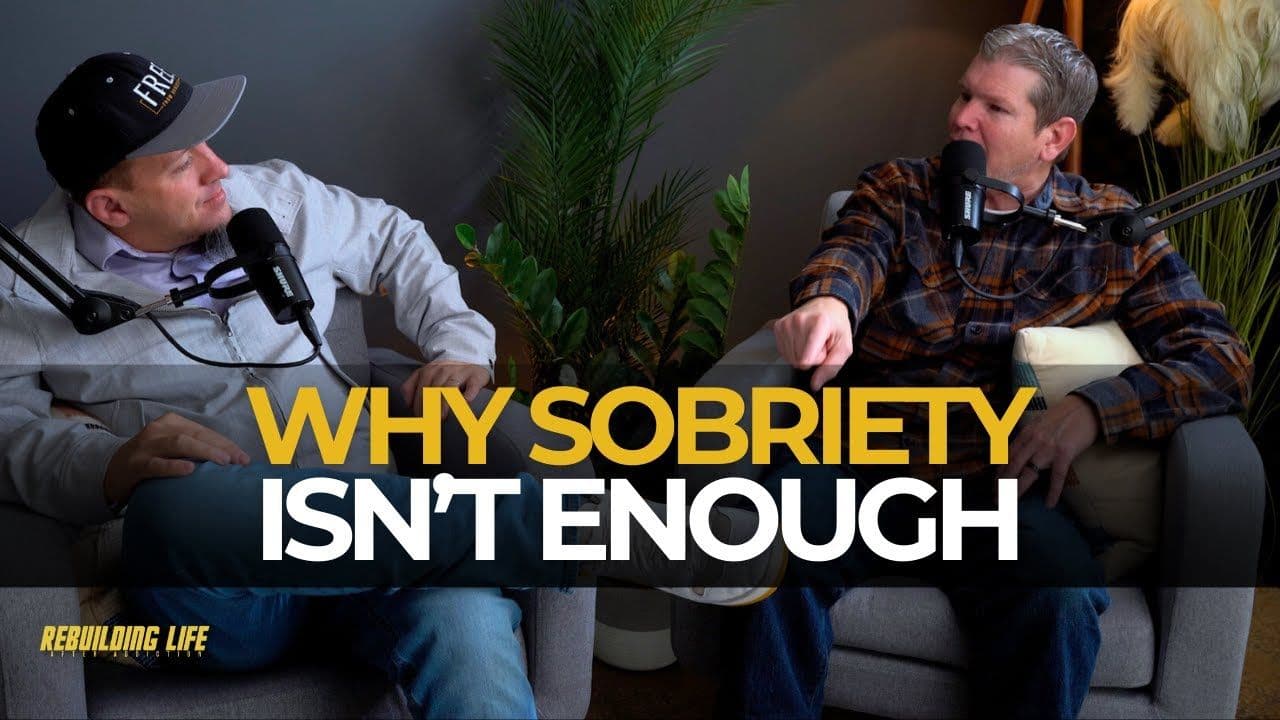
There's a difference between being sober and being free.
I learned this the hard way over years of recovery work-watching people hit milestones, stack up clean time, and still be absolutely miserable. They weren't using, but they weren't living either. They were just surviving, white-knuckling their way through each day, hoping the craving would eventually disappear.
My recent conversation with Matt, pastor of Brookside Church, unpacked this tension in a way that I haven't heard before. Matt's been clean for years, but his journey to freedom took much longer than his journey to sobriety. And the gap between those two things? That's where most of us get stuck.
The Bootstrap Trap
Matt started our conversation with a question that cut straight to the core:
"If you could go back to yourself when you were sober for six months, knowing all that you know now, what would you say?"
His answer was brutally honest:
"I was trying to willpower it. I'm trying to grit my teeth and do my best to obey. I was born on my bootstraps. I was trying to do everything. I can stay clean. Yes, I've done six months. And that's only by your grace, God. But let me never get... I'm starting to feel pretty good about the six months of sobriety, even looking down on some that aren't sober yet."
This is the trap most of us fall into. We get clean, we stack up some time, and suddenly we start measuring ourselves against others who are still struggling. We think we've figured it out. We think we've earned something.
But Matt said something that stopped me in my tracks:
"I would just tell myself these things: Don't seek to learn a bunch of amassed knowledge for Bible jeopardy. Seek to know God. Use the Bible as an onramp to know him. Not to know knowledge and to prove everybody I know all this stuff."
From the Altar to the Testimony
When we hear addiction stories in church, we usually hear one of two things:
- The conversion moment-"I met Jesus and everything changed"
- The victory lap-guys like Matt and me who are 15-20 years out
What we don't talk about is the grit and struggle of that first year. The messy middle between the altar and the testimony five years down the road when you've got your family back and life is good.
Matt's first year of true freedom wasn't instantaneous. It wasn't a "wham, bam, thank you Jesus" moment where everything clicked into place.
"My first year of true freedom," he said, "it was not instantaneous. Most of the time in life, it's never really the destination that God's after. It's more of the journey that we learn through."
The Difference Between Jesus Died FOR Me and Jesus Lives FOR Me
This is where Matt's story gets really interesting.
He knew Jesus died for his sins. That's Christianity 101. But for years, he missed something critical:
"I had known that Jesus died for my sins, but for some reason I never picked up that he lived for my righteousness. He died for me. But I didn't know he lived for me. So therefore, somebody's got to live. He died. Now somebody's got to live, and that's going to be me. And I'm going to pull up my bootstraps. I'm going to get my gear on, my headband, my workout like a Rocky movie. I'm going to get fit. I'm going to get off the drug. I'm going to do this."
He paused.
"And I failed miserably. Again and again and again."
The problem wasn't effort. Matt had plenty of effort. The problem was that he was trying to live FOR Jesus instead of letting Jesus live THROUGH him.
"It wasn't until I realized that he gave me his righteousness and that right now, in the sight of God, whether I made a mistake today or I didn't, I'm seen as spotless, perfect, and clean in his eyes."
This is what I call the Robe phase of restoration-understanding that your identity in Christ isn't based on your performance, but on His righteousness given to you.
Breaking the Cycle: From Probation Christianity to True Freedom
Matt described what I call "probation Christianity"-this cycle where you're doing great, then you slip up, and suddenly you feel disqualified from God's presence.
"The old me would fall. Well, I got a bag, I smoked weed, I'm done. God's mad at me now. He's pretty ticked off when I come into a room, he's pretty much holding his nose like, back out. Come back when you're clean. Come back when you've got yourself together."
So what would happen? He'd finish the bag. Buy some pills. Might as well blow the whole thing since he already messed up anyway.
"I mean, I'm ruined now. God hates me."
But then something shifted:
"Once I realized he loves me, once I realized that the sins I can't forget, he can't remember. Once I realized that when I did smoke that weed, I could have thrown it on the ground and crushed it and said, 'God forgive me.' And he said, 'Yes, come, son, come to me.' Then I began to live a consistent life, not a life of 'I sinned, now I'm on probation.'"
This is the freedom we're all chasing-not the freedom to sin without consequence, but the freedom to run TO God instead of FROM Him when we mess up.
Your Apology Sucks: Why We Try to Negotiate With Grace
I told Matt about a video I did recently called "Your Apology Sucks," which unpacks the prodigal son's terrible apology.
On its face, the son's speech seems humble: "I'm not worthy to be called your son. Make me like a hired servant."
But here's the problem: He's trying to negotiate a payment plan with someone who's offering him a pardon.
"The father's coming with your pardon right here," I said. "And we're like, 'No, no, no. Here's my terms of payment. Let me work it off. Let me do 8 hours a day over here. Let me make payments to you.' And it's like you're refusing the gift."
Matt jumped in: "The father had the robe. He had the ring. He had the sandals. All three those things. The son's trying to negotiate. And the Bible says the father had servants and they brought the robe, put it on him, put the ring on him and sandals on his feet. In other words, the father ignored his terms and forced the gift on him."
Think about that for a second.
The father FORCED the gift on him.
"You can't earn it," Matt continued. "I can't make it, even if I get saved, even if I do all this great stuff and I do these 12 steps and I join all these groups and I do all these things and I white knuckle it through and I grit and I make it through 18 months sober. Praise God. But I'm not putting the robe on and the ring on the sandals. I'm still trying to work it off and pay for it."
He looked at me: "Dude, just take the ring. Just take the robe."
The Golden Ticket Problem
Matt hit on something that explains why so many people stay sober but never find freedom:
"We try to teach a salvation that is a ticket to heaven. We try to sell this golden ticket and we say, 'Hey, you should get saved so you can not go to hell.' And so there's nothing in that of 'I should get saved because I love him and because my spirit man leaps at just his very presence.'"
When salvation is just fire insurance, it gets old quick.
"I remember getting the golden ticket. Okay. That's great. Now what? You know, like, that was good for a weekend. But then like, I still want to smoke weed. I still want to do these pills. I got my golden ticket, but I'm kind of bored now."
The problem is we're not pursuing a relationship. We're just trying to keep the ticket.
"I wasn't getting into a true relationship. I wasn't pursuing a love of him. I was just trying to keep the ticket. I was just trying to get saved. Okay, I walked the aisle. I filled out a card. I said the prayer. I believed in my heart. I confessed with my mouth that Jesus Christ is Lord."
Check. Done. Saved.
But still miserable.
Trust and Obey: We Got Half the Equation
There's an old Appalachian saying: "Trust and obey, for there's no other way to be happy in Jesus."
Matt grew up with that song. And for years, he only heard half of it.
"Okay, I'll obey. Check, check. And that's all I got was obey. I obey, obey, obey, obey, obey. I do. I do. I do. I follow your Ten Commandments, God. I do this and I do that. I obey. I do. But I forget the first word of the chorus: trust."
He paused.
"I didn't trust him at all. I was trying to obey, but I never trusted him. I was trying to do a bunch of works, but I never got into a relationship."
This is where the rubber meets the road. You can obey all day long and still be empty. You can follow all the rules, check all the boxes, and still feel dead inside.
Because obedience without relationship is just religious performance.
"Once you get into a relationship," Matt said, "that's a real deal. Not to win her favors, not to win her hand in marriage, not so that you can impress her or get something from her. But because you love her. Because you want to love her. I want to love God. I don't want to do a bunch of things to get stuff from God or to get his praise. I want to serve him because I love him."
The Inside Job: Why External Sobriety Isn't Enough
Matt said something that perfectly captures why sobriety without freedom leaves us empty:
"We get free on the outside. But we never dealt with the inside. We get the heart transplant, right? The Bible says that he's circumcised the heart. He's removed the heart of stone and given us a heart of flesh. We get this new heart, but we never nurture it. We never put deposits in it. We never get into the word. We never spend time in prayer. There's no deposits made. And if there's no deposits made, you're not going to have a withdrawal when you need to make that withdrawal."
He looked at me: "You're bankrupt in your spirit. Your spirit is starving. You're not getting fed from the word. You're not getting that nourishment that you need. In my case, I was starving because I spent no time with them. We had no relationship. I just was trying to be a good boy now. That's great. Be a good boy. But you got to spend time with them first."
The Two Sermons That Changed Everything
I shared with Matt about two sermons that broke me open in my recovery journey.
The first was Andrew Wommack talking about grace and the righteousness of Christ. I'd heard it a thousand times, but something about the way he said it just destroyed the theology I grew up with.
"My goodness, you just rocked my world with this message. The message was about how he loved me in my worst state and he couldn't love me any more today than he did at my worst. And we need to stop trying to go to God with all of this junk."
The second was David Wilkerson talking about the danger of a believer loving their sin more than the Savior. He unpacked Psalm 51-David's psalm after the whole Bathsheba disaster-and the message was clear:
You're capable of anything. I'm capable of anything. And I need to posture my heart to always stay in the position of repentance.
Not returning to my old lifestyle. But keeping my heart tender to the conviction of the Holy Spirit.
The Six-Month Pride Trap
I asked Matt about something he said earlier-about feeling pretty good at six months sober and starting to look down on people who were still struggling.
"How do we stay humble in recovery? How do we not fall into that trap?"
His answer was simple but profound:
"I think it's bowing at the cross daily. Bowing at the cross, whether you feel like it or not, whether you want to or not, whether you're going through a good day or you just relapsed. The cross is where you go. Back to the cross is where freedom is."
He brought up Revelation 5, where John sees the Lamb in heaven-still bearing the scars.
"In heaven, Jesus is still wearing the scars. Why? Those scars are eternal. The cross is where we go back to. And I'm not talking about crucifying him fresh every time. I'm talking about going back to the cross to say, 'I can't do this. I am crucified with Christ. Nevertheless I live, yet not I, but Christ that lives in me.'"
Then he said something that hit me hard:
"When I'm at six months and I'm feeling good about six months and all of a sudden I see someone struggling, and I'm like, 'Man, I'm just thankful that's not me, God.' He knows my heart. I try to trick everybody and trick God, but he knows me. If I'm starting to see like, 'Oh, it's not me. I'm above that now. I'm not like that.' Once I start separating myself from the sinner, I have now separated myself from my lifeline."
Because Jesus came and died for us when we were yet sinners.
"So the quicker I admit that I'm a sinner, the quicker I get to my lifeline. I'm not an addict. I'm also not an ex-addict. I'm not a recovering addict. I'm just a person that needs God. I'm a sinner. He came and died for me and forgave me and gave me his righteousness."
Healing the Holes in Your Soul
Toward the end of our conversation, a young man commented on one of our shorts. He said he'd used addiction to cope with mental illness, and now that he was off the drugs, he was wrestling with the mental illness again.
I asked Matt what he'd say to that young man.
His response was visceral:
"If I were to cut my arm here, I'd have a gash. And that would actually allow the bacteria and the oxygen and all that to get in there. So what do you do? You close it up to decrease infection. Well, in my life, in addiction, you get these lashes in your soul, these open wounds that are in your soul. And these allow depressions, these allow all these things, these thoughts and mental illness and all these things to come in. And what you need is healing of those inner wounds."
He leaned forward:
"You have holes in your soul that you try to take money and stuff it in the hole. It can't fill the hole. You try to take action. Maybe if you could just finally achieve this, or get a nicer car, or get the nice rims you like, or even sobriety-anything-you stuff it in the hole. But there's only one thing that can fill the holes of the soul, and it's Jesus and his presence and his voice. And when he comes into you, he fills all the soul's holes. Everything is filled by him."
His message to anyone stuck between clean and free:
"Surrender. Give up. Cry uncle. It took me 40 years. I'm still learning to just stop. Just give up. And I don't mean give up as far as go use. I mean give up your gritting of your teeth, your bootstrapping. Give up that whole thing and come to Jesus Christ. Many people come to church, but they've never come to Christ. Come to Jesus. Just come to him."
The Root Beneath the Symptom
Matt said something that every person in recovery needs to hear:
"Every addiction has a root. And ask the Spirit of God, ask Holy Spirit, ask the father to show you the root. Why am I using? The using is just a simple symptom. The heroin's just a symptom. The meth, the pills, the weed, the vape. It's just a symptom of something deeper. So ask God to reveal those wounds in your soul."
Maybe you need to forgive the way your dad treated you. Maybe your mother. Maybe a friend. Maybe a betrayal. Maybe you lost a loved one too early. Maybe you were abused.
"Ask God to reveal that to you. And that's the first step. Just go to that root. Just ask God to give it to you and realize that when you come to him, you're not there to perform. You're there to enjoy and just to be with your father."
Matt's voice softened:
"I don't knock on my front door. I walk right in. You just walk into your house and you're comfortable there. And it's the same with the throne of God. Stop looking at your sin. The sin you can't forget, He cannot remember. He's tossed it away. Stop looking at your sin. Look to the Son. Look at him. Look away from yourself. Your solution's not in you."
He finished with this:
"Water can't help you when you're drowning. Fire can't put out fire. And you can't cure you. It takes someone else outside of you. You need him. And he's with you now. He'll never leave you or forsake you. Romans 8 says there's no condemnation for those who are in Christ. So if you're in Christ, rebuke the devil out of your life. Resist him and begin to live a life of surrender. Live a life of secret prayer. Live a life of Bible reading."
And then, almost as an afterthought:
"Don't get so bogged down with all the Bible. Just small doses. 'The Lord is my shepherd. I shall not want.' I'm not going to want drugs today. He's my shepherd."
The Journey From Clean to Free
Sitting with Matt reminded me why I do this work.
Because there are thousands of people right now who are sober but not free. They're clean but still carrying the weight. They've put down the substance but picked up religion, performance, and shame.
They're trying to bootstrap their way to freedom, not realizing that freedom isn't something you earn-it's something you receive.
Matt's been walking this journey for years, and he's still learning to surrender. Still learning to stop trying and start trusting. Still learning that Jesus didn't just die FOR him-Jesus lives FOR him.
And that changes everything.
Because when you realize that your sobriety isn't about your willpower but about His presence, when you understand that you're not performing for approval but resting in acceptance, when you finally stop negotiating with grace and just receive the robe, the ring, and the sandals-
That's when sobriety becomes freedom.
That's when you stop just surviving and start actually living.
This conversation with Matt is part of what I call the Robe, Ring, and Sandals framework-a biblical approach to moving from recovery to restoration. Read the complete guide to rebuilding life after addiction.
Matt serves as pastor of Brookside Church in Middletown,VA. You can find his weekly sermons on the Brookside Church YouTube channel.
Hear more on our podcast: Clean but Miserable: Why Sobriety Alone Isn't Enough
Justin Franich
Justin Franich is a Teen Challenge graduate who overcame a meth addiction and has been clean since 2005. He spent over a decade leading Christ‑centered recovery programs and now serves as Executive Director of Shenandoah Valley Adult Teen Challenge, helping families find the right path forward and supporting people as they rebuild life after addiction.
Read my story →Still rebuilding? You're not alone.
I send weekly encouragement for people walking through the hardest season of starting over.
You can unsubscribe anytime.
Related Articles
We're Only As Sick As Our Secrets: Why Transparency Sets You Free
The things we hide hold power over us. But when we drag our struggles into the light with people we trust, shame loses its grip and real healing begins.

How to Let Go of Guilt and Shame After Addiction
Still carrying guilt after getting sober? Learn how to release shame, receive forgiveness, and stop letting your past define your recovery.
When Recovery Hurts More Than Addiction
Nobody told me recovery might hurt worse than addiction. At 3 AM with drug dreams and racing thoughts, I was mad at myself, mad at everyone, and angry at God. The pain almost broke me before I realized it was actually healing me.

How to Move Beyond Your Broken Past
Struggling with a lack of hope while dealing with a loved one's addiction? Discover how God can transform your broken pieces into a beautiful masterpiece and why accepting Christ's forgiveness is the first step toward moving forward.